Why Does It Matter to Bring Coaching to Everyone?.

We have been building Kima for about a year now, with the initial idea that if we could provide elite-level coaching to more athletes, we could raise the floor and reduce the gap between those who have access to resources and those who don't.
It was a fairly intuitive belief. If more people had access to coaching, more people would improve, and this felt obvious because coaching, at its best, provides structure, guidance, and direction.
But as we spent more time building Kima and speaking with players, that belief started to feel incomplete because it did not fully reflect how people actually approach training and why they look for coaching.
After many conversations, we realized that most people getting value from coaching are not trying to go pro or reach elite levels. They are trying to improve, to feel progress, to understand what they are doing, and to make their effort actually lead somewhere.
At the same time, access alone does not change how results are distributed. Players already in strong environments continue to accumulate advantages through better coaching, facilities, and networks, while opportunities at the highest levels remain limited. Even if coaching became more accessible, those differences would still exist.
So we started looking at the problem differently.
Instead of asking how to bring coaching to everyone, we started asking what coaching actually changes in the learning process itself, at an individual level.
How people actually train.
Most people who want to improve a physical skill tend to follow a similar path.
They practice regularly, watch content, and rely heavily on how movements feel in the moment. This works to a certain extent in the early stages, when progress is easier to see.
But over time, the process becomes less reliable.
The content they consume becomes less relevant to their specific patterns, and their proprioception (their internal perception) becomes less accurate as the margin for improvement narrows. Mistakes do not always feel like mistakes, and small deviations begin to build up without being clearly identified.
At that point, progress slows down in a way that is hard to explain. From the outside, it looks like a plateau. From the inside, it feels like effort is no longer turning into results.
And that's usually where frustration builds, and where many people lose consistency or stop altogether.
What coaching changes.

This is where coaching becomes the most valuable, because it introduces an external layer of observation while also shaping how the athlete interprets what they are doing, which affects both execution and confidence over time.
A good coach is able to identify what actually matters in the movement and translate it into feedback that can be used right away or shortly after the rep, and also giving enough clarity for the athlete to stay focused on what matters instead of second-guessing every action.
There is a continuous link between what the athlete thinks they are doing and what is actually happening, and that link is where most of the value comes from, yet most athletes are not equipped to build it on their own.
Repetition is still needed, but it becomes directed, because you are not just repeating the same movement and hoping it improves, you are adjusting along the way based on what you are actually doing and on external feedback.
Errors get spotted earlier, before they turn into habits and over time, these corrections stick and turn into long term progress.
That kind of feedback is hard, and often impossible, to recreate alone.
Experiencing it directly.
I noticed this clearly when I worked with a personal trainer for almost a year.
He structured the sessions, tracked progression, and made adjustments based on what he observed, which meant that I did not need to constantly question whether I was doing things correctly or whether the plan made sense at that moment. I could focus on execution, while he handled the adjustments and made sure I was not repeating the same mistakes over time.
The result showed up physically, but the more interesting part was how I approached training. There was a clear sense of direction, and very little uncertainty in what to do next.
When that external feedback disappeared, I slowly drifted back to guessing. Some movements stayed, others degraded, and over time it became harder to tell what was improving and what was not.
I experienced first-hand how that lack of clarity compounds. Execution becomes less precise, results become less consistent, confidence drops, and motivation follows. That becomes a loop that is hard to break without external input.
Why it does not scale.
The limitation is that this model does not extend easily.
High-quality coaching depends on time, attention, and expertise, which makes it constrained, expensive, and hard to scale in a consistent way. Most people who train regularly do so without consistent access to that level of feedback.
So they rely on repetition, content, and internal perception to guide their progress, which brings them back to the same limitations, and often leads to reinforcing the wrong patterns over time.
Narrowing the problem.
This is where the question becomes more specific.
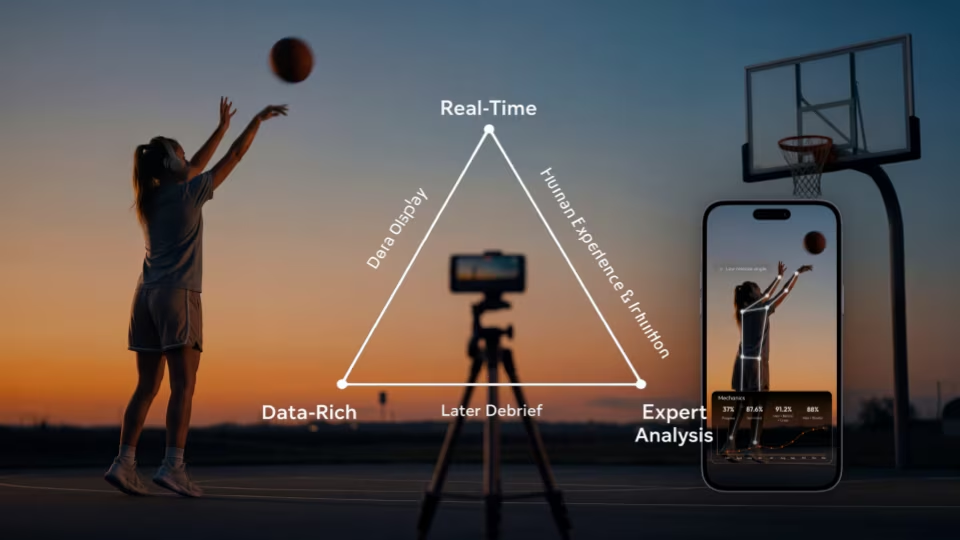
What happens when part of that feedback loop becomes available more often, closer to the moment of action, and at a lower cost?
Not the full coaching experience, and not a replacement for human relationships, but something more focused: the ability to receive accurate feedback close to the moment of action, and to have a consistent external reference that understands you and how you move.
What starts to change.
It is still early, but a few patterns are starting to appear.
It becomes easier to understand whether what you are doing is correct while you are doing it, which reduces the gap between action and understanding and allows adjustments to happen earlier in the process.
Over time, this changes how people relate to their own progress.
Confidence starts to come from seeing a clear link between effort and outcome, rather than from external validation. Practice becomes more deliberate, and each repetition carries more information instead of being another guess.
We have also seen players using Kima describe this as a shift toward more deliberate practice, and in some cases even a form of flow during training.

What does not change.
This does not change the structure of competition.
The highest levels remain selective, motivation still varies, and strong environments continue to create advantages. Skill coaching is only one part of what determines how far someone goes.
What changes is the experience of learning.
Fewer people remain stuck without understanding why they are not progressing. More people can train in a way that is informed rather than based on guesswork. The distance between effort and improvement becomes easier to understand and act on, and progress becomes something they can track with more clarity.
Reframing the original question.
Over time, the initial question takes a different form.
Bringing coaching to everyone becomes less about equalizing outcomes, and more about improving the quality of the learning process itself, where better-timed and more reliable feedback reduces the amount of effort lost to misalignment.
Today, a lot of progress still relies on repetition and trial and error, where people put in effort without always knowing if they are reinforcing the right patterns. The goal is not to remove repetition, but to make it more useful.
At the individual level, this shift is not marginal. It changes how people experience training, how they make decisions within a session, and how they interpret their own progress over time.
At scale, that compounds.

Where we are now with Kima.
We are still early in understanding the full implications of this.
What is already visible is a first effect. When feedback becomes more reliable and better timed, people spend less time guessing and more time adjusting.
Instead of only tracking outcomes and trying to work backwards, they start to understand what drives those outcomes in the first place. Instead of just tracking makes and misses, players start to understand why a shot goes in or not. And that's applicable across any sports and any physical skill.
Training becomes easier to navigate, and easier to stick with, because progress is no longer abstract.
Improvement becomes something people can see, understand, and influence.
That is already a meaningful shift.