The Coaching Feedback Trade-off Triangle — and Why It May Finally Be Breaking.
In sport, coaching is often described in broad terms — motivation, leadership, mentorship. Those matter, but at a more technical level, performance coaching is a simpler and more mechanical process.
It is the improvement of performance through structured practice, instruction, and — most critically — feedback.
When you strip it down, skill development is driven by feedback loops. An athlete performs an action, receives information about that action, and adjusts. The speed and accuracy of that loop largely determine how quickly they improve.
And yet, despite all the advances in sports science and technology, most coaching systems still operate within a fairly stubborn constraint.
The structure of the trade-off.
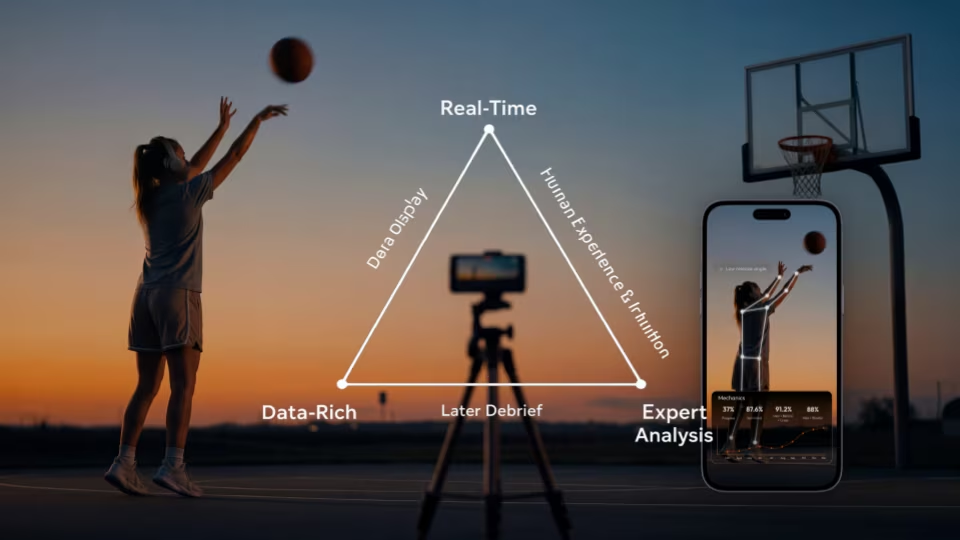
In practice, three variables define the effectiveness of feedback:
- the quality of the insight
- the speed at which it is delivered
- the depth of the data behind it
Historically, you could get two of these — but not all three at once. That trade-off becomes clearer if you look at how coaching actually happens.
Three familiar approaches.
The first is live, in-the-moment coaching.
A good coach watches an athlete and gives immediate feedback. When the coach is experienced, the insight can be sharp and highly actionable. But it is largely based on observation and experience. There is a limit to how much a coach can measure or quantify in real time.
The second is data dashboards and wearables.
Here the situation flips. You have plenty of data — often in real time — but very little interpretation. The athlete can see numbers, trends, and outputs, but is left to figure out what to change. Data accumulates faster than understanding.
The third is video analysis and post-session review.
This is where you often get the highest-quality insight, supported by detailed measurement. But it comes later — sometimes much later — after the repetitions are already done.
What this looks like in practice.
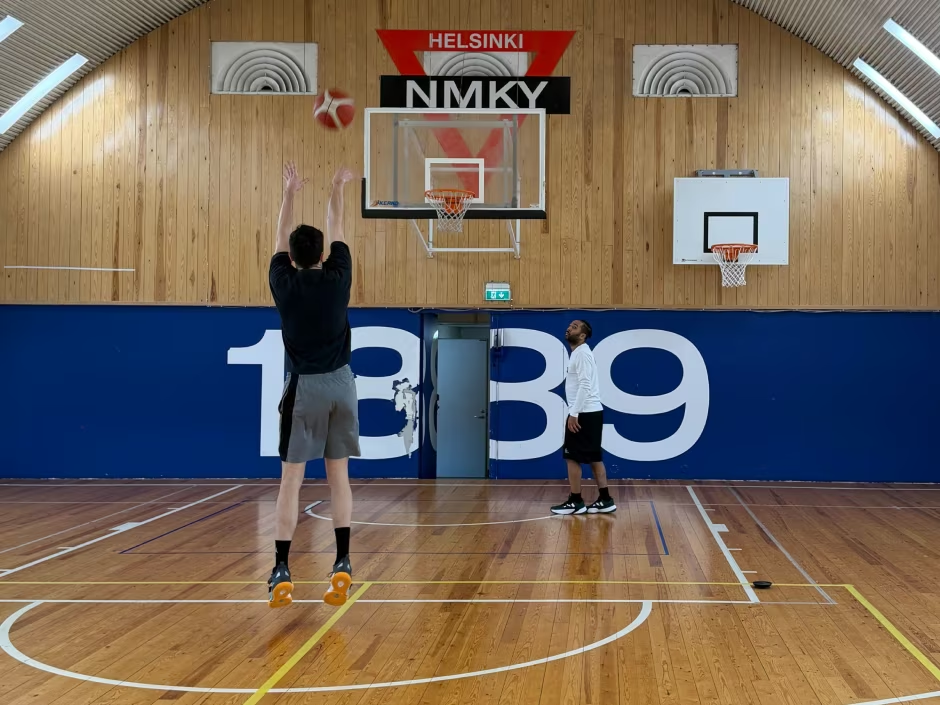
Take a simple case: a basketball player working on their shot.
In one session, they take 50 shots without any meaningful feedback. They may have a general sense of how it feels, but no clear signal on what is working or what is not. Some of those repetitions are useful. Many simply reinforce whatever pattern already exists — good or bad.
In another session, the same player takes 50 shots, but after each attempt receives a clear, specific cue tied to what actually happened — something grounded in measurable aspects of their motion, delivered quickly enough to influence the next shot.
The difference between those two sessions is not effort or intent. It is the quality and timing of feedback.
Over time, that difference compounds.
Why the trade-off matters.
This is where the constraint becomes more than a technical curiosity.
When feedback is missing or incomplete, athletes don't just fail to improve — they believe they are improving when they are not. Practice time is spent, but it is spent reinforcing the wrong thing.
At the same time, high-quality coaching remains difficult to scale. It depends on the presence of experienced individuals, and even the best coaches can only observe so much, for so long. Meanwhile, data is increasingly available but often underutilized — collected, displayed, but not fully translated into action.
The result is a system where neither human expertise nor available technology is used to its full potential.
What is starting to change.
The underlying constraints behind this trade-off have shifted.
Modern mobile devices now have enough processing power to handle tasks that, until recently, required desktop or in-cloud analysis. Video can now be processed in near real time on the device that players already carry — their phone. Movement can be tracked and measured as it happens, where it happens. No lab or extra equipment required.
Computer vision models are improving in their ability to extract structure from motion — not just where something is, but how it moves, how consistently, and how it changes over time.
And newer AI systems are fast, flexible, and rival human insight at turning raw outputs into expert guidance — translating data into feedback that an athlete can actually act on, using human-quality audio that speaks directly to the athlete.
None of this replaces a great coach. But it does start to extend and scale certain aspects of coaching that were previously limited.
The potential shift.
Taken together, these developments point toward something that has not really been possible before. It becomes feasible to combine meaningful data, high-quality interpretation, and expert feedback delivered in a way that connects — flexible, context-aware text and audio that feel familiar to, and resonate with, the player.
In other words, to begin closing the feedback loop within the training session itself — and often within the sequence of repetitions. When that happens, the nature of practice changes.
Instead of: perform → finish → review
You move toward: perform → measure → adjust → repeat
Continuously.
What that changes.
In recent work, I've seen early versions of this loop operating in real time — imperfect, but already materially different from traditional training. The implications are clear.
Practice becomes more efficient. Each repetition carries more value. Feedback becomes less episodic and more continuous.
And access to effective coaching broadens beyond the relatively small number of athletes who consistently work with top-tier coaches.
The shift is not just in tools, but in the unit of improvement — from sessions and reviews to individual actions.
A closing thought.
For a long time, coaching has operated within a set of practical constraints that forced trade-offs between speed, depth, and quality of feedback.
Those constraints are starting to collapse.
It is not yet fully solved, and there are still real challenges ahead. But for the first time, it is reasonable to expect systems that observe performance, understand it, and guide improvement in the moment it is happening.
As that becomes reliable — and today I have seen it working in practice — the question is not whether coaching changes.
It is how much faster athletes improve when the feedback loop is no longer the limiting factor.